The-Penis.com |
Variations in Appearance of the Penis:Skin blemishes and variations of the penile shaft and glansMany variations of the normal penis are cause by circumcision: skin bridges are the prime example of this. Frenulum breve and other variations are congenital; while Fordyce spots and papules are a feature of the penile skin that develops through life, often causing great distress to the owner of the penis concerned. Frenulum breve Refers to a situation where the frenulum is too short. The example on the left is rather a mild case; the one on the right is not. This will certainly make intercourse uncomfortable, and if the frenulum tears during sex, as it may well do, it will heal with a scar which effectively makes it even shorter than it already is, leading to a repeated cycle of tearing, bleeding and healing. Simple surgery can solve the problem. R Stuart has a comprehensive website on frenulum breve. Click here to go to it.
Webbed penis Refers to a situation where the skin of the penis and the scrotum is connected so that it looks like they are webbed. This can produce discomfort during intercourse and may look unsightly. If the webbing is extensive, surgical correction may be possible.
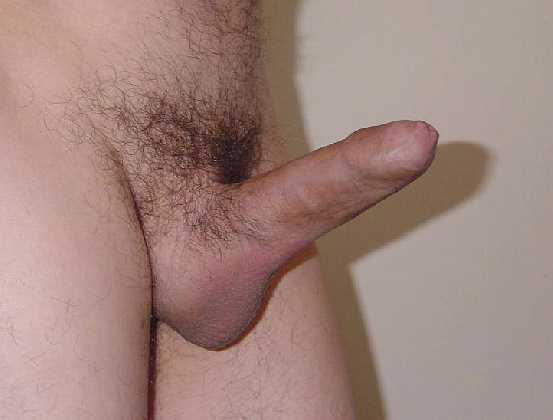
Circumcision scars and skin tags Incompetent circumcision may result in protruding skin tags and uneven development of the penis at puberty. This website has a comprehensive collection of pictures showing what can happen as a result of a botched circumcision. A page with some relevant pictures is located here. Note that the circumcision scar seems to produce a ring where the color of the skin of the penile shaft changes. This represents the point at which the inner and outer foreskin were separated during circumcision. It is "normal", at least in the sense that it occurs on all men who have had the enforced removal of their penile skin imposed on them at birth.
Skin bridges These little tags between the coronal rim of the glans and the skin of the shaft are formed as a result of a botched circumcision. This is a useful link for more information.
A reader writes:
A skin bridge, more properly called in
medical terminology a "penile adhesion," is not the result of a poor
circumcision so much as it is a result of poor or improper care of the
penis during healing after the procedure. This photo is not from the correspondent above.
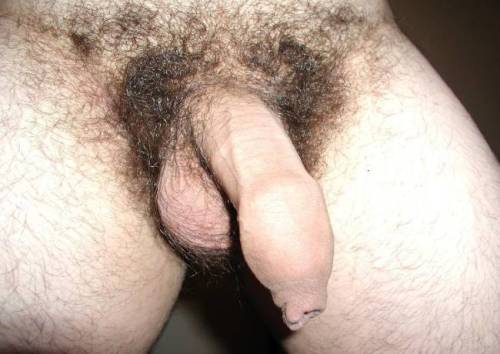
"Double" urethral meatus Although this occurs rarely, the penis can form two urethrae during its development. The duplication may be complete or partial, and the duplicated urethrae may be functional or non-functional. In the photo here, there appears to be two urethral meati (openings) separated by a thin piece of tissue. If it is only the opening which is affected in this way, the dividing tissue may be removed. In more serious cases of extensive urethral duplication, surgical intervention may be need to correct the problem. This should not be confused with hypospadias, where two openings may develop on the shaft of the penis, one representing the correct location of a normal urethral meatus and one representing a hypospadic meatus.
The raphe The raphe is a normal element of penile development; it is the line along which the component parts of the penis fused during their development in the uterus. It is more prominent in some men than others and extends along the surface of the scrotum.
Fordyce spots These cause men a great deal of distress and anxiety, and it is true that they can be unsightly when whole areas of the penis are covered with them. However, they are normal, in the sense that all men have them (and so do some women, on the skin of their labia). They are modified sweat glands, of a type which form only on the skin of the genitals, and they cannot be removed by washing, scrubbing, ointments, lotions or potions. A more complete discussion of Fordyce spots can be found on https://www.the-penis.com/problems.html
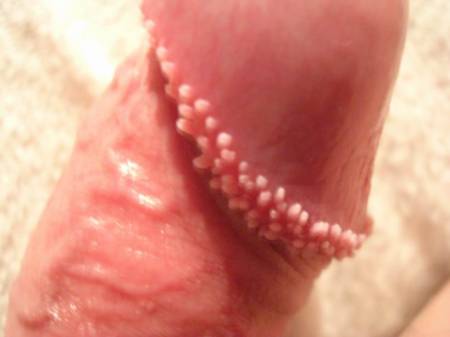
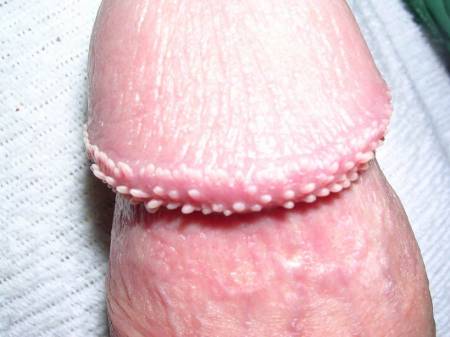
Pearly penile papules Another every distressing skin blemish, though I believe this one can actually be treated by a dermatologist (I think by using cryogenic freezing techniques). Anyone with personal experience of their removal is most welcome to write in and let me know how its done. Or you can research the subject on Google.
Phimosis Tightening of the foreskin so that it will not draw back over the head of the erect penis is known as a phimosis. Phimosis is often present from birth, but since the foreskin can only be drawn back in boys as it gradually separates from the glans from the age of about five onwards, this is often not discovered until the boy has grown up a bit and begins to enjoy penile play or starts trying to draw his foreskin back to wash underneath it. In many cases the phimosis is only discovered when a boy begins to masturbate at puberty, when he finds that his foreskin won't slide back and forth over his glans, or the tightness of the skin over his erect penis produces an uncomfortable erection. In some cases the cause of the phimosis is a fungal infection, which may mean circumcision is needed. However, there is a simple enough stretching technique which a boy can try to resolve the problem. It's described here. R Stuart has a very good website on the subject.
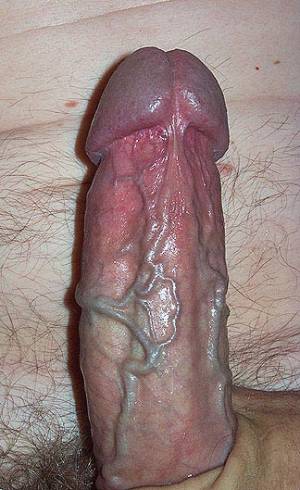
Prominent veins If your penis has a load of prominent veins on it, there isn't unfortunately much you can do about it other than learn to live with it. It might be an idea to thrust gently during intercourse because exposed and prominent veins like this can sometimes responds with inflammation to vigorous rubbing. Or maybe you should just use extra lube!
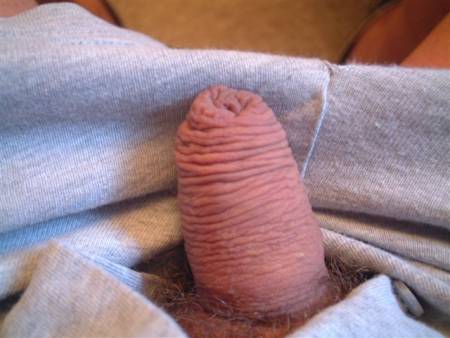
Wrinkly skin on soft penis Although I have had a few queries from bys about how they can solve their "wrinkly skin problem", I don't think there is anything abnormal about this. The penile skin has to expand and contract as a penis gets larger and smaller during its erection, and when it retreats into its sheath of foreskin, as in the first picture, it will naturally assume a wrinkled look. As you can see from the images of that penis getting erect, when it is bigger, the wrinkled appearance disappears.
|
|